Create Popup Forms
Need a signup form with some pop?
Then you should try the tinyEmail popup form. Our Popup option hovers a sticky form on every web page. It's designed to be a call to action (CTA) that, well, isn't easy to ignore.
Other forms
Looking for a different form style? You can also create an embedded form or flyout with tinyEmail.
- Oh, BTW, we also have a growing library of prebuilt forms. Click to learn more about these templates.
To build a popup form, add an audience and create the structure. After that, quickly customize the design.
Starting a form
The first step is to launch the workflow and assign an audience. The audience database is where you build your subscriber list.
- Log into your account and click Forms on the top menu.
- Click the Create form button.
- In the pop-up window, enter a unique form name.
- Select an existing audience.
- Select an audience where your customers will be added. Optionally, you can create a new audience (see below).
- Click the Save & Continue button to open the Form builder.
Creating a new audience
If you don't want to connect the form to an existing list, create a new audience.
- Click the subscriber field.
- Enter a unique name for the new audience (i.e. list).
- Click the plus (+) icon and Save & Continue.
The first step is now complete!
Creating the popup
When the Form builder opens, you'll see four menu tabs at the top of the screen. Each tab opens a different set of controls and customization options.
- Appearance Customize the form's shape and design (see below).
- Content Add or remove form fields and configure component properties (we show you how in a different article).
- Editor The form builder canvas.
- Preview Quickly see what the form looks like.
The Form builder page doesn't have an auto-save function. That's because the changes you make to a published form automatically appear in the live form (e.g. on your website). If you're working on a draft or unpublished form, be sure to click Save at the top of the Code page.
Appearance
Form type
Under the Form type heading, you'll find three options. Select Popup.
Selecting a trigger
Now choose a trigger for the form (the event that causes the form to display). The default setting is Show on page load.
- Show on page load Displays the form on every page load.
- Show based on rules Check a box to enable one or both rules and then change the default settings (optional).
- Only show on custom trigger Choose this option to trigger the form with a custom event. This is an advanced feature, so you’ll need some JavaScript skills to add code that fires an event on your site (e.g., a button click or mouse action).
Form details
Scroll down to the Form details heading. This is where you can customize the size of the popup. Adjust the width and height so that the form looks good on your site. You can define form sizes with pixels (e.g. 600px) or percent (e.g. 50%).
Customize the background color or leave it blank (neutral). Use the color picker to select an option. Open the font selector and choose a specific typeface or leave the default Inherit option enabled. If you select Inherit, the form's code picks up the default font on your website, a time-saving feature that helps maintain a consistent look on your site.
- FYI Any changes you make to a published form appear almost instantly on your site's live form. If you can't see the changes, refresh the website page.
Form success message
Add a short message that lets subscribers know they were added to the list.
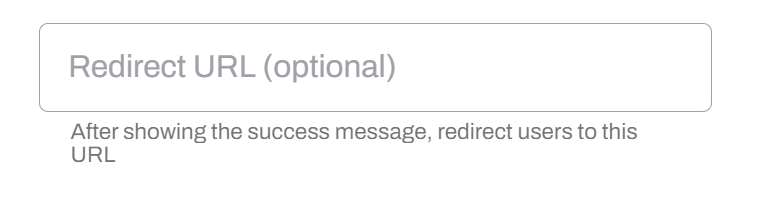
Add a Redirection URL
You may also specify a redirect URL. Once the success message is displayed, users will be automatically redirected to the provided URL.
Enable double opt
Final steps
Now that the popup form structure is ready to go, click here and learn how to:
- Customize layout orientation.
- Add or remove components.
- Configure component properties (e.g. field labels, font color, cell alignment, etc.)
- Copy the form code to install on your site.
You may also check Custom Attributes in Forms